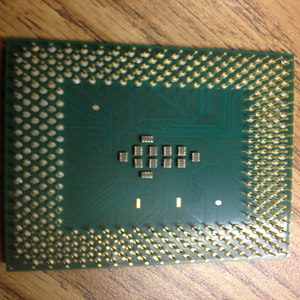
Processor
-
The processor is the brain of the computer, as it controls all of its functions. It preforms tasks, called "programs", one by one. It controls devices that are hooked up to the motherboard. It rests in the motherboard's CPU socket. Sometimes CPUs have multiple "cores", which basically means it has more than one processor in the same chip. This makes the computer able to perform more tasks faster.
Other names for the processor include "central processing unit" (CPU), and microprocessor.
Main parts of the processor
- Arithmetic Logic Unit (ALU) – Does mathematical problems that make up computer programs. This allows the computer to function.
- Control Unit – Starts and stores all the results of the ALU.
-
When looking to purchase a processor it is important to take into account its clock speed and bandwidth. Faster clock speeds allow the processor to process data faster while higher bandwidth lets it process more data at a time. A processor's on board cache is important when running games and 3D applications, but not for everyday tasks. Cooling is also a wise investment to prevent the processor from giving errors and burning up.